Self-directed learning / IT & cybersecurity
I built one system to study cybersecurity—and another to practice the judgment.
The Cybersecurity Academy gives my learning structure. Incident Shift gives me a place to apply it. Together they form a loop: learn a concept, make a decision, review the evidence, identify the weak point, and choose what to practice next.
Why I built it
Passive study was not enough.
I wanted a learning process that made me retrieve what I knew, explain it clearly, use it in unfamiliar situations, and revisit weak areas instead of moving on because I had watched a video or recognized a term.
The goal is not to collect points or rush through material. The goal is to improve how I investigate, make safe decisions, verify outcomes, and communicate what should happen next.
Private learning system
Structure for learning, evidence for progress.
Private, local learning system in active development. It is not a school, accredited program, certification, or promise of employment.
Cybersecurity Academy is my private, mastery-based learning environment for IT and cybersecurity fundamentals. It combines closed-note retrieval, guided practice, labs, explain-backs, practical assessments, direct correction, spaced review, and progress tracking.
It adapts to the work I actually complete. Weak skills return for correction and unfamiliar retesting; demonstrated skills can move forward. Progress is based on evidence, not attendance, streaks, or confidence alone.
What it helps me practice
- Foundational IT and cybersecurity concepts
- Authorization and defensive-safety boundaries
- Troubleshooting and evidence-based reasoning
- Explain-backs and professional communication
- Retrieval over time instead of one-time recognition
- Honest goal and progress tracking
Public browser game
Practice the decision, not just the definition.
Public prototype in active development. It complements hands-on labs, administration practice, cyber ranges, and certification study; it does not replace them or prove job readiness.
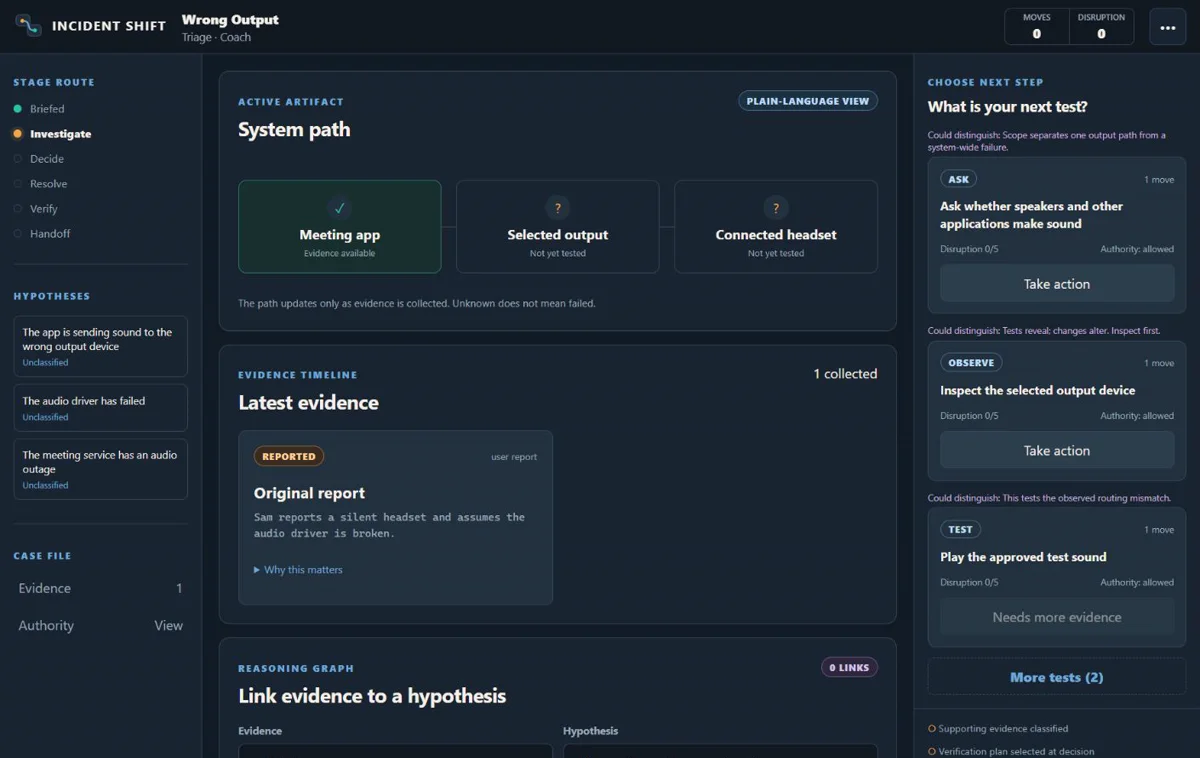
Incident Shift is a realistic browser game where you work synthetic IT and defensive-cybersecurity cases—read the ticket, inspect evidence, choose the next safe test, fix or escalate the issue, verify the outcome, and leave a clear handoff.
ClaimEvidenceSafe testActionVerificationHandoff
Scenarios are deterministic and synthetic. The game rewards investigation quality, authorization, safety, verification, and communication rather than speed alone.
What it helps me practice
- Establishing scope before acting
- Separating a report from verified evidence
- Connecting evidence to competing explanations
- Choosing safe, informative tests
- Respecting authority and knowing when to escalate
- Verifying that the outcome actually improved
- Writing a bounded professional handoff
How they work together
One learning loop, two different jobs.
- 01
Study
Use Cybersecurity Academy to learn and retrieve a concept without leaning on recognition alone.
- 02
Practice
Use Incident Shift to apply that concept inside a bounded troubleshooting decision.
- 03
Review
Examine the evidence, missed alternatives, unsafe assumptions, verification, and handoff quality.
- 04
Adapt
Use the weak point to select the next lesson, lab, retest, or scenario instead of repeating material blindly.
What this work demonstrates
The software is part of the evidence. The process matters too.
Building these systems has required me to define the learning goal, separate scoring from real competence, set safety boundaries, create deterministic scenarios, test the experience, review failures, and decide what should change next.
The projects demonstrate product direction, structured problem solving, privacy and safety judgment, iterative testing, and the ability to turn a personal learning need into something concrete and reviewable.